

I was talking to a fellow linguist recently about how different it feels to visit a country where you speak the language, Germany in my case, or Italy where I do not. The enjoyment of language is different and the linguistically curious mind wanders. Having recently returned from Sicily, I found myself pondering a question that has probably occurred to many visitors to Italy. Why do Italians seem to involve their entire upper bodies in a conversation? Hands wave, fingers point, shoulders rise and eyebrows arch. Sometimes, the gestures appear almost as important as the words themselves.
It is tempting to put this down to the Mediterranean sunshine. Perhaps spending more time outdoors encourages a more expressive style of communication. Or maybe the warmth simply makes people feel more relaxed and sociable. After all, who needs to keep their hands in their pockets when the sun is shining?
But what about the contrast with countries such as Germany and Sweden? Conversations there can seem rather more restrained to an outsider. Does a German discussing a technical specification really need to wave their arms about? Would a Swede describing a beautiful sunset consider raising their voice, let alone both hands?
Interestingly, this isn’t just a stereotype. A 2024 academic study by researchers Graziano and Gullberg, published in Frontiers in Communication, found measurable differences in how Italian and Swedish speakers use gestures. The research suggests that the distinction is not simply about how much people gesture, but also about how they use gestures to communicate.
Of course, these are sweeping generalisations, and anyone who has spent time in different countries will know that individual personalities vary enormously. Nevertheless, there are genuine cultural differences in how people use gestures, facial expressions, personal space and silence to communicate.
For professional linguists, this raises an interesting question. Language is far more than vocabulary and grammar. Meaning is conveyed through tone of voice, body language and cultural context, too. A gesture that seems perfectly natural in Sicily might be unfamiliar, or even confusing, to someone from Scandinavia. Equally, a thoughtful silence in one culture might be interpreted as awkwardness or disapproval in another.
So, is it the weather? Probably not, at least not directly. Social conventions, cultural history and learned behaviour are likely to be more important than the climate. Still, after a few days in beautiful and wonderfully varied Sicily, I began to wonder whether my own hands were becoming more expressive.
Perhaps the sunshine really does get into everything, even the way we talk! Do contact us with your thoughts.
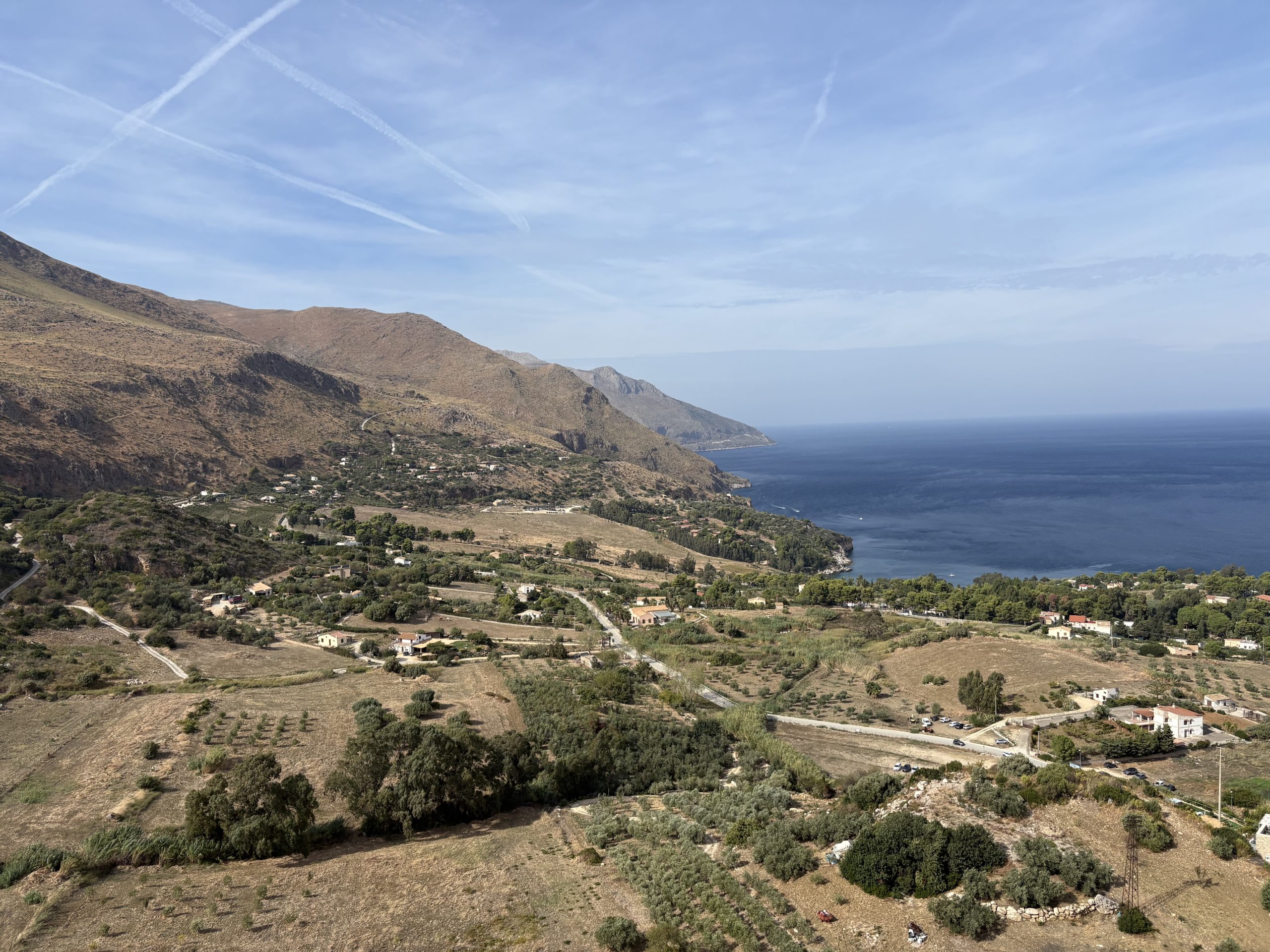
The picture was taken above Scopello on the North-Western coast of Sicily..